
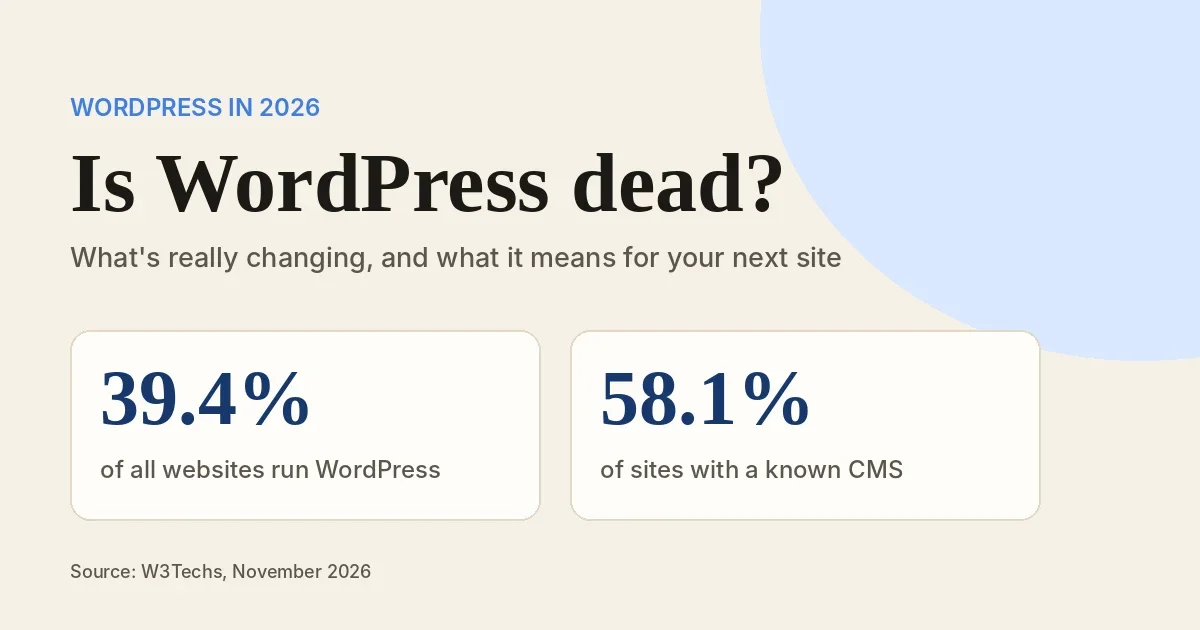
"WordPress is dead" is one of the web's longest-running headlines. It's not true, but the way people talk about WordPress has clearly changed. Here's what the numbers actually show, why the "dead" story keeps coming back, and what it means for how you build your next site.
What the numbers say
According to W3Techs, in November 2026:
- WordPress runs 39.4% of all websites, roughly 4 in every 10.
- Among sites that use a known content management system, WordPress has 58.1%: more than every other CMS combined.
- It powers everything from small blogs to enterprise sites, major publishers and online stores through WooCommerce.
That's not a dead platform. But the trend is real, too:
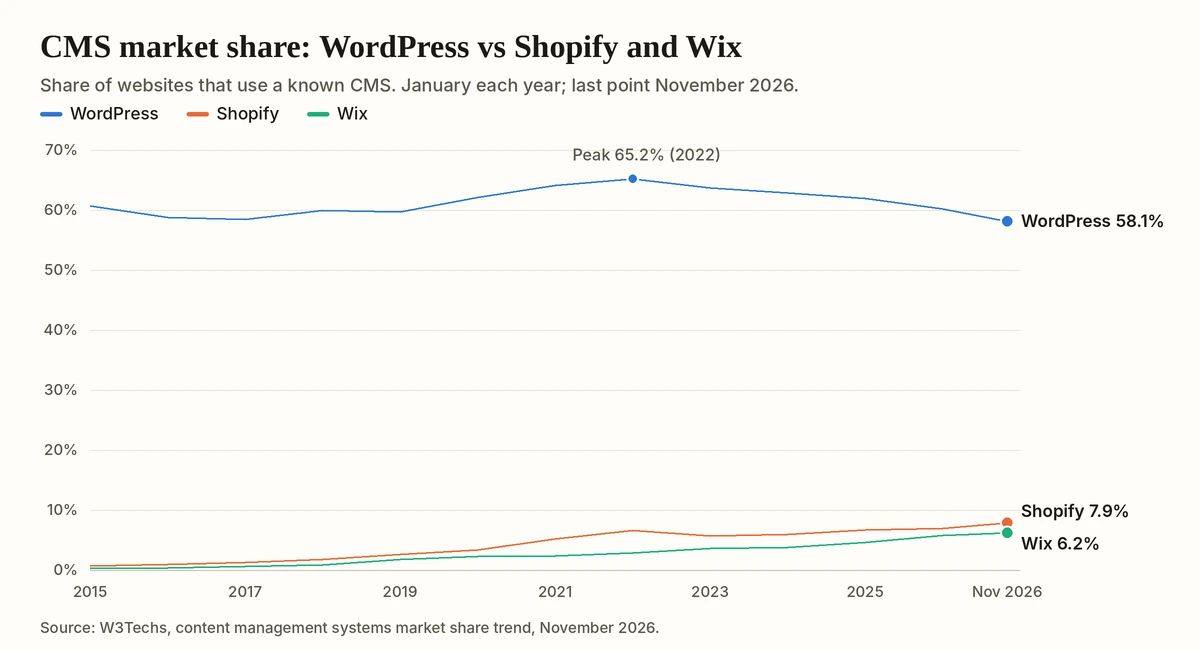
| Share of sites with a known CMS | Jan 2015 | Jan 2022 (WordPress peak) | Nov 2026 |
|---|---|---|---|
| WordPress | 60.7% | 65.2% | 58.1% |
| Shopify | 0.7% | 6.6% | 7.9% |
| Wix | 0.3% | 2.9% | 6.2% |
WordPress has given back about 7 points since its 2022 peak, while hosted platforms like Shopify and Wix keep growing. In other words, it's losing share at the edges, not collapsing.
So why does everyone keep saying it's dead?
The narrative comes from three real shifts in how websites get built.
1. Modern alternatives took the simple sites
For brochure sites, landing pages and portfolios, many developers and hobbyists have moved away from a traditional CMS. They use static site generators and frameworks such as Astro, Hugo or Next.js, or hosted builders such as Webflow, Framer, Wix and Shopify. These give developers cleaner workflows, or give non-developers an instant no-code setup, without WordPress's updates, security patches and hosting to look after.
2. The bloat and plugin trap
WordPress can feel bloated. Build a site on a heavy multipurpose theme, a dozen overlapping plugins and a slow visual page builder, and it will crawl. Plugins are also where most WordPress security problems come from, rather than WordPress core itself. Critics point at that mess and call the whole platform obsolete. (We covered this in more depth in Do you still need a premium WordPress theme?)
3. The old way of building WordPress is what's dying
Modern WordPress isn't just an old blogging script anymore. It now supports:
- Headless (decoupled) setups, where WordPress is only the content backend and a modern JavaScript framework delivers a fast front end.
- Cloud and command-line workflows that remove the hassle of local development environments.
- AI integration: WordPress 6.9 added the Abilities API to core, and the official MCP Adapter plugin lets AI agents use a site's abilities through the Model Context Protocol.
When WordPress still wins, and when it doesn't
| Your project | Good fit |
|---|---|
| Content-heavy site, blog or publication with several editors | WordPress |
| Online store with custom needs and full data ownership | WordPress + WooCommerce |
| Membership site, user roles, custom business logic | WordPress |
| Client who wants a familiar admin dashboard to edit their own site | WordPress, or a lighter CMS |
| Small brochure site, portfolio or landing page that rarely changes | Static site or a hosted builder |
| Store where you want everything hosted and managed for you | Shopify |
| Developer team building a custom app-like front end | A framework, optionally with headless WordPress behind it |
Build WordPress lean, or keep your options open, with Canvasly
If the "dead" feeling usually comes from how a site was built, the fix is to build it lean. And if you're not sure WordPress is the right home for a site, it helps not to have to decide up front. Canvasly Web Studio is built for both:
- Design once, publish anywhere. Design visually in Canvasly, then export the same project as a static site, as WordPress pages or posts, as a React (Next.js) or Astro project, or as a Payload CMS your client edits themselves. If a brochure site later needs WordPress, you export again instead of rebuilding.
- Lean WordPress pages. The WordPress export turns each page into a standard Custom HTML block with only the CSS and JavaScript that page uses. There's no heavy theme or page builder to slow it down, and your theme can't break the design. See how to export to WordPress, React and Payload CMS.
- AI-ready. Plan a whole site with the AI Site Planner, or connect Claude Code, Claude Desktop or Cursor through Canvasly's MCP server to build pages with live sync and undo.
Prefer to work inside WordPress? Sidcraft Page Builder is our free, lightweight builder. It loads no CSS or JavaScript on pages that don't use it, and Sidcraft Pro adds an MCP server so AI agents can work on your site.
The verdict
WordPress is losing some ground at the edges to hosted platforms and static tools, but it is far from dead. It's still the default choice when a project needs data ownership, user management, custom business logic, or an admin dashboard a non-technical client can actually use.
The platform isn't dead. But build it carelessly, with too many plugins and too much theme, and it will certainly feel like it is.
Frequently asked questions
Is WordPress dead in 2026?
No. According to W3Techs, WordPress runs 39.4% of all websites and 58.1% of sites that use a known content management system, more than every other CMS combined. Its share has slipped from a peak of 65.2% of CMS sites in 2022, mostly to Shopify and Wix.
Why do people say WordPress is dead?
Three reasons: simple sites now often go to SaaS builders or static site generators; heavy themes, overlapping plugins and slow page builders make many WordPress sites feel bloated; and the old way of building WordPress sites is giving way to headless, cloud and AI-driven workflows.
When should I still choose WordPress?
When you need to own your data, manage users and roles, add custom business logic, or give non-technical editors a familiar admin dashboard. It is also strong for content-heavy sites and WooCommerce stores.
When is WordPress the wrong choice?
For a small brochure site, landing page or portfolio that rarely changes, a static site or a hosted builder can be faster, cheaper and need almost no maintenance.
Can AI agents work with WordPress?
Yes. WordPress 6.9 added the Abilities API to core, and the official MCP Adapter plugin exposes those abilities to AI agents through the Model Context Protocol.
Market-share figures: W3Techs, "Usage statistics of content management systems" and its yearly trend report, retrieved November 2026. WordPress, WooCommerce, Shopify, Wix, Webflow, Framer, Astro, Hugo and Next.js are trademarks of their owners. Canvasly is not affiliated with or endorsed by them.